
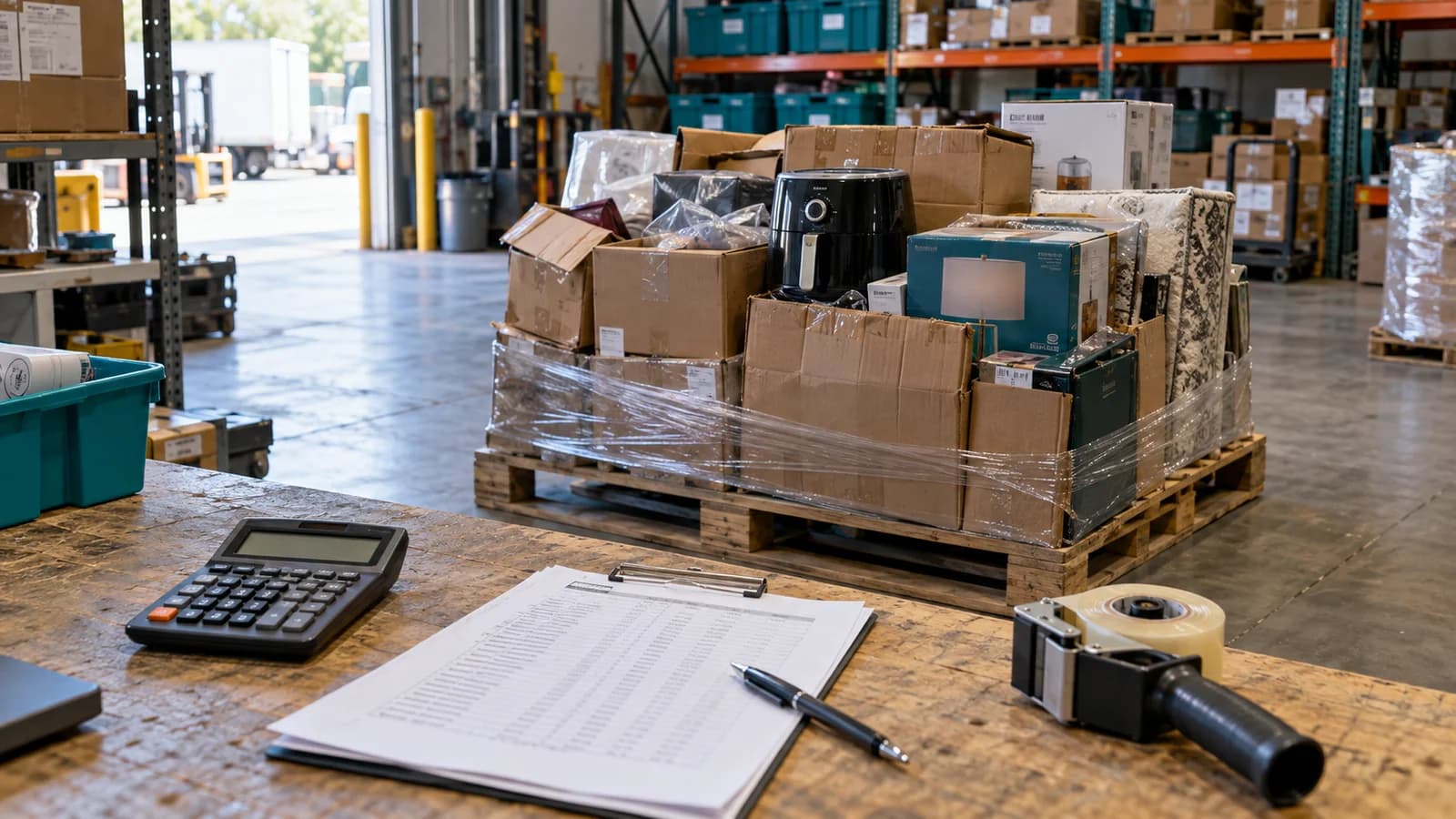
A pallet with $10,000 in stated retail value is not a $10,000 resale opportunity. Before you bid, estimate what you can sell, subtract the costs, and decide how much cash to risk.
In the worked example below, the maximum bid is $927.27. That number comes from $4,000 in expected sales, not the retail total. It includes a buyer premium, freight, selling costs, and a spending reserve.
These are illustrative assumptions, not a real pallet or a promise of profit. The calculation follows PalletWorth's shared percentage-of-bid economics function. Other estimator policies can produce different results.
Start with what you can sell
Suppose a manifest lists 100 units and $10,000 in retail value. Your inspection and price research support this planning case:
- 80 units can sell for an average of $50 each.
- 20 units contribute no sales revenue within your planning period.
- Expected gross sales are 80 times $50, or $4,000.
The 20 units might be incomplete, damaged, or too uncertain to price. Assigning them zero is a buying assumption, not proof that they are worthless. Do not count speculative salvage proceeds to rescue a weak bid.
Choose a sales horizon that fits your business. Stock that might sell in a year cannot pay next month's freight bill. The example assumes the 80 units sell within your chosen period. It does not predict how long that will take.
Match each price to the product's model, condition, and included parts. A sealed retail item is a poor comparison for an untested return. A sold listing for a replacement lid is not evidence for the value of a complete appliance.
Separate buying costs from selling costs
This example uses a 10% buyer premium on the winning bid. Freight into your warehouse is $300.
Selling the 80 units also costs money:
- Selling fees: $600, using a 15% planning allowance on $4,000 in sales.
- Outbound shipping: $400, using $5 per sold unit.
- Packing and handling: $100, using $1.25 per sold unit.
- Refunds and other losses: a separate $100 reserve.
Those selling costs total $1,200. The unsellable units already reduced revenue. Do not subtract their full sale value again as a loss reserve.
The 15% fee is an assumption, not an eBay fee quote. Actual fees depend on your category, account, order totals, and optional services. Use the current eBay fee schedule or your own sales records to set the allowance.
This example assumes no additional acquisition tax or storage expense. Add applicable tax, inspection, storage, labor, and disposal costs before bidding. If your shipping quote excludes a liftgate or appointment fee, include those too.
Set the budget before calculating the bid
We choose a spending budget equal to 70% of expected sales. That is $2,800. We then hold back 10% of that budget, or $280.
The remaining $2,520 must cover the bid, buyer premium, freight, and selling costs.
This 10% reserve is not a promised 10% profit margin. It is a deduction from the spending budget. Profit margin and return on cost are separate outputs.
Here is the arithmetic:
- Expected sales: $4,000.
- Spending budget: $4,000 times 70% = $2,800.
- Budget reserve: $2,800 times 10% = $280.
- Available for the bid and premium: $2,800 minus $280 minus $300 minus $1,200 = $1,020.
- Maximum bid: $1,020 divided by 1.10 = $927.27, rounded to cents.
The formula for this policy is:
budget = expected sales * budget percentage
reserve = budget * reserve percentage
max bid = max(0, (budget - reserve - freight - other costs)
                  / (1 + buyer premium rate))
PalletWorth's shared function uses cents for money and basis points for percentages. For this example, the inputs are 400000 cents, 7000 budget basis points, and 1000 reserve basis points. Freight is 30000 cents. Other costs are 120000 cents. The buyer premium is 1000 basis points with the PCT_OF_BID fee model.
This example puts seller fees in other costs. The percentage-of-bid fee field represents only the buyer premium. Do not put the seller fee in both places.
Check the result against total cost
At a $927.27 bid, the rounded buyer premium is $92.73. Add $300 freight and $1,200 selling costs. Total planned cost is $2,520.
Against $4,000 in expected sales, planned profit is $1,480. Profit divided by total cost is about 58.73%. Profit divided by sales is 37%.
These estimates depend on the assumed prices, saleable quantity, and costs. They are not verified resale results. If the auction accepts whole-dollar bids, stop at $927 or the next permitted increment below your limit.
Stress-test the two assumptions that can sink the purchase
If only 70 units sell at $50, expected sales fall to $3,500. Scaling the selling allowances to those sales gives $1,050 in other costs. With the same budget policy and $300 freight, the maximum bid falls to $777.27.
If sales stay at $4,000 but freight rises from $300 to $500, the maximum bid falls to $745.45.
Neither change looks dramatic on a manifest cover sheet. Both change what you should pay. If a small assumption change makes the current bid unattractive, the apparent discount to retail offers little protection.
What to do before your next auction
A seven-point liquidation pallet bidding checklist
- Confirm the inventory. Compare the row quantities with the auction total. Check whether a row describes individual items, packs, or sets. Duplicate descriptions do not always mean duplicate inventory, but they deserve a closer look.
- Research the valuable rows first. Start with items contributing the most to expected sales. If one uncertain product drives half the revenue, resolving that match matters more than refining a dozen inexpensive accessories.
- Separate condition groups. Price tested, complete units separately from untested or incomplete stock. Keep a note of which condition assumptions came from the seller and which remain your own assumptions.
- Get a delivered freight quote. Use the actual destination, pallet count, and receiving requirements. Confirm which charges are included rather than borrowing the shipping price from a previous auction.
- Estimate the cost to sell. Include marketplace charges, packing, outbound delivery, returns, and your handling time. A local sale and a shipped order can produce different net proceeds at the same advertised price.
- Choose a downside case. Reduce the saleable quantity or expected unit prices. Keep fixed costs fixed. Do not assume every expense falls just because fewer items sell.
- Write down the stopping bid. Save the calculation before the auction closes. If new facts arrive, recalculate. If another bidder simply pays more, that does not improve your economics.
Three mistakes a pallet profit calculator cannot fix
Counting shipping twice, or not at all. In this example, expected sales exclude customer shipping payments, and outbound shipping is a cost. If your revenue includes shipping collected from buyers, account for that income consistently. Your marketplace may also charge fees on amounts beyond the item price.
Treating all stock as immediately saleable. A manifest tells you what is listed in a lot, not which units will pass testing. Reserve time and money for inspection. If you have no basis for a saleable percentage, describe the uncertainty instead of using a precise-looking number without support.
Using gross margin when you mean return on cost. Here, $1,480 divided by $4,000 gives a 37% margin. Dividing the same profit by $2,520 in cost gives 58.73% ROI. Neither number includes income tax or an annualized return. A slow-selling lot and a fast-selling lot can have the same calculated ROI while tying up cash for very different periods.
Frequently asked questions about max bids
What percentage of retail should I pay for a liquidation pallet?
There is no percentage that makes every lot a good buy. Two pallets with identical retail totals can differ in condition, demand, freight, and saleable quantity. Build the bid from expected sales and costs. Our guide to manifest retail value versus resale value explains why the retail headline is an unreliable shortcut.
Is the maximum bid the same as my auction invoice?
No. The max bid is the limit for the winning bid itself. In this example, the auction-related acquisition cost includes the $927.27 bid, $92.73 premium, and $300 inbound freight. That totals $1,320 before selling costs. Your actual invoice may include different charges or taxes, so check the auction terms before bidding.
What if the calculation produces a negative number?
The shared calculation returns a zero bid floor. That means the planned costs and reserve consume the available budget before you pay for inventory. It is a reason to pass or investigate a specific assumption. It is not a reason to remove freight or count unsupported salvage income until the result becomes positive.
How should I review the pallet after selling it?
Keep the original estimate alongside actual proceeds. Record units sold, sale prices, fees, shipping, refunds, and time spent. Review unsold stock at the end of your chosen sales period. Those records help you improve the next bid and show whether the largest error came from price, condition, or costs.
Set your limit before the auction closes
Keep the manifest, price evidence, freight quote, and cost assumptions together. Mark prices as sold comparisons, AI estimates, or unpriced. A number without its evidence type is hard to audit.
Use PalletWorth to review your manifest before buying. Then check the assumptions against your own selling channel. The useful output is a defensible stopping point, even when that means passing on the pallet.
By PalletWorth. The cover is an AI-generated editorial illustration, not a photograph of customer inventory. All worked-example figures are hypothetical; they are not customer results or guaranteed returns.