
The retail total on a liquidation manifest can be mathematically correct and still give you the wrong buying signal. It describes a retail reference price. It does not tell you what buyers will pay for the stock in front of you.
That distinction matters most when a pallet contains returns, missing accessories, or products with uncertain condition. A discount to retail is not a profit calculation.
The headline challenges that shortcut. It is not an accusation that every seller fabricates manifest prices. The more useful question is what each unit can return after selling costs, with evidence you can inspect.
What our stored data can actually support
Before looking at our data, separate three questions: What did the product retail for? What could this unit sell for now? What can you afford to pay after costs? A manifest retail total answers only the first, and sometimes it is an estimate of that reference price.
For example, B-Stock Supply's auction submission guidance describes retail per unit as MSRP or estimated original retail price. It also warns that stated retail values are estimates it has not verified. Read the terms for the specific marketplace and lot you are buying; one marketplace's description is not a guarantee about another seller's inventory.
We reviewed PalletWorth's stored analyses on October 21, 2026. We excluded known internal accounts and analyses named as tests, samples, demos, benchmarks, or comparisons. We retained the latest completed legacy analysis per account and stored manifest path.
That screened group contains 18 analyses across five accounts. After excluding manually edited and overridden rows, it contains 1,721 rows representing 4,996 units. Of those, 1,235 rows representing 3,130 units have both a positive retail reference and a positive stored resale estimate.
This is a small, selected dataset. A row can represent multiple units, so row counts and unit counts answer different questions. Reuploads under different file paths can remain. An account is not proof of an independent business or a verified sale.
Most importantly, these are estimates saved by the legacy engine, not completed sales by PalletWorth customers. The source labels in the matched group are SearchAPI and eBay official. Those labels alone do not certify an individual price as a condition-matched sold comparison.
No category-and-condition group meets our publication threshold of at least five analyses across three accounts. Even categories pooled across conditions do not pass that threshold. We will not turn this sample into claims such as "electronics recover 40% of retail."
The defensible finding is narrower: many units lack the paired data needed even to compare a stored estimate with retail. A portfolio-wide recovery percentage would hide that missing evidence.
Why a category discount is not enough
Category helps organize research. It cannot replace product and condition matching.
For electronics, confirm the model, capacity, power supply, and test status. A working device and a parts-only unit belong in different price groups. An accessory sold under the same brand is not a comparable device.
For small appliances, check completeness before price. A missing bowl, charger, lid, or attachment can change both the buyer pool and your repair cost. Compare the exact package you could list.
For housewares, verify the unit of sale. A manifest row may describe a set while a marketplace listing describes one piece. Quantity and bundle errors can overwhelm a seemingly precise unit price.
These are review checks, not measured recovery rates from our dataset. We need more independent, matched observations before publishing category benchmarks.
Seven reasons manifest retail value can mislead buyers
- The reference price may be old. A product's original price can remain on a manifest after newer models arrive or retailers discount the remaining stock. Research current alternatives a buyer could purchase, not just the original launch price.
- Retail assumes a different condition. A new item with intact packaging is a different offer from an untested return. Even an unused product can need a lower price if the box is damaged or important documentation is missing.
- The package may be incomplete. A charger, remote, bracket, lid, or attachment can determine whether a buyer can use the product. Check the cost and availability of replacements before counting a complete-unit resale price.
- Quantity may mean the wrong thing. A six-piece set is not six complete sets. Read the description and unit fields together. Resolve bundle ambiguity before multiplying a comparable price by the manifest quantity.
- Demand is not included. A plausible selling price says little about how long you may wait for a buyer. Consider your selling period, competing supply, and the number of identical units you would need to move.
- Revenue is not profit. Marketplace charges, delivery, testing, packing, and returns come after a sale. The spread between retail value and your auction bid ignores much of the work required to collect cash.
- Missing evidence can disappear inside a total. A large resale estimate may depend on a handful of expensive rows. Check both how many units are priced and how much of the estimated value relies on weak matches.
These checks are useful even when every retail entry is accurate. The problem is using a reference price to answer a resale question it was never designed to answer.
Build the value from individual units
Consider an illustrative row with ten units at a stated retail price of $100. The retail extension is $1,000.
Suppose eight complete units could sell for $45 each. The remaining two are unpriced because their condition is unknown. Your planning revenue is $360, with zero assigned to the uncertain units for the buying decision.
That is not $360 in profit. You still need to deduct seller fees, shipping, packing, returns, acquisition costs, and your required return. Nor is it a measured 36% recovery rate for every item in that category.
A better record keeps these facts separate:
- The manifest retail reference and quantity.
- Product identity, condition, and completeness.
- The comparable price range and evidence type.
- Units you expect to sell within your chosen period.
- Selling costs and the resulting buying limit.
If the product identity is uncertain, investigate before treating the price as support for a bid. An expensive wrong match is worse than an honestly unpriced row.
Sold comparisons, AI estimates, and unpriced items
A sold comparison records a transaction for another item. It helps when the model, condition, date, currency, and package match. It does not guarantee that your unit will sell for the same amount.
An active asking price is different evidence. It shows what a seller wants, not what a buyer paid. Do not quietly mix asking prices into a sold-price claim.
An AI estimate can help prioritize research when direct evidence is sparse. It still needs an estimate label and visible assumptions. It cannot create a sale that never happened.
An unpriced item needs investigation or a conservative buying assumption. Zero in a bid calculation can mean "no supported value counted," not "proved worthless."
When reviewing a report, ask which of these types support the total. Also ask how much inventory has no evidence. A high total supported by a few units deserves a different decision than broad coverage across the lot.
From resale value to a buying limit
A practical manifest review worksheet
Use one row per distinct product and condition group. Keep the original manifest fields unchanged so you can trace the seller's information back to the source. Put your research in separate columns:
- Exact model, variant, and unit of sale.
- Quantity listed and quantity you expect to sell.
- Condition, missing parts, and testing assumptions.
- Price evidence type, date, and source reference.
- Low and central resale estimates with the reason for each.
- Per-unit selling costs and lot-level costs.
- Unresolved questions that could change your bid.
Sort that worksheet by expected resale dollars, not by retail dollars alone. Review the largest uncertain contributors first. If those rows cannot be matched, recalculate without their speculative value. The result may be less exciting, but it is easier to defend when deciding how much cash to commit.
Keep low-value rows in view too. A large number of cheap products can create substantial handling work. An average selling price hides that labor when a few expensive products sit beside hundreds of low-value accessories.
After estimating sales, calculate what remains after costs. Freight belongs in the calculation even if the auction page displays it separately. Buyer premiums and seller fees apply at different stages.
The max-bid worked example shows how $4,000 in expected sales produces a $927.27 buying limit under explicit assumptions. The number is not a universal rule. It changes when the saleable quantity, freight, or cost policy changes.
Before your next purchase, compare the retail headline with the evidence underneath it. Review a manifest in PalletWorth, keep uncertain prices visible, and set the bid from expected proceeds rather than the advertised discount.
Frequently asked questions about pallet resale value
Is MSRP useless when reviewing a manifest?
No. It can help identify an item or flag a row that deserves closer research. It also lets you check the seller's quantity arithmetic. The mistake is treating MSRP as expected revenue or applying a fixed discount without checking the inventory.
Should I use the highest sold price I can find?
Not as your default. Examine why that result is high: a different variant, better condition, extra accessories, or a different quantity may explain it. Use a range of relevant observations where available, and document the reason for your chosen planning price.
Does an unpriced row mean the item has no value?
No. It means your review has not established a supported value. You can research it, inspect it, or make a clearly labeled conservative assumption. Do not quietly turn an unknown into a confident sale price just to complete the spreadsheet.
Can I compare retail recovery rates across categories?
Only when the underlying data supports the comparison. You need consistent quantities, conditions, selling periods, and evidence definitions. Our current screened sample does not support category benchmarks. A simple category percentage would imply a level of certainty this review cannot provide.
Methodology limits
The snapshot includes completed legacy analyses created before October 22, 2026 at 00:00 UTC. We excluded known staff domains, internal name markers, administrator-owned accounts, and manual price edits. We deduplicated stored paths within accounts, not file contents across all uploads.
The dataset has no verified customer sell-through ledger in this review. Stored resale estimates are not actual realized revenue, despite internal field naming. We publish only aggregate counts here. No customer identity, manifest path, product-level customer data, or individual purchase appears in this article.
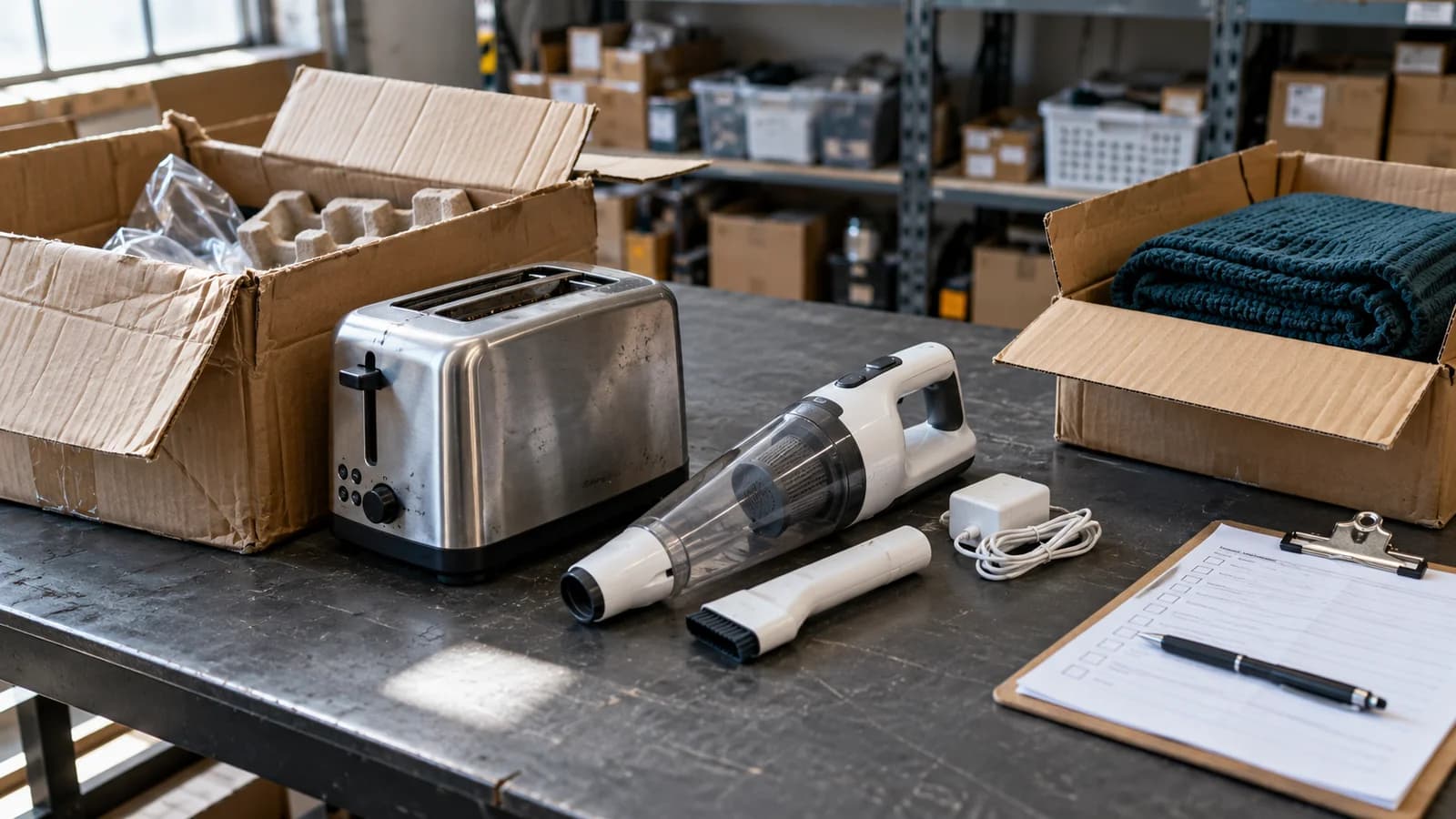
By PalletWorth. The cover is an AI-generated editorial illustration, not a photograph of customer inventory. The ten-unit example is hypothetical and separate from the aggregate dataset.