
A pallet labeled Grade A can mean something different from Grade A on another seller's website. Customer returns may include unused products, incomplete packages, or failed units. Overstock describes an inventory situation, not a universal inspection standard.
The useful question is not which label sounds best. Ask what the seller actually checked, what condition the products are in, and what work you must do before selling them.
This guide separates inventory source, function, appearance, completeness, and packaging. Keeping those facts apart helps you compare liquidation pallet condition grades without treating an attractive label as a guarantee.
Why grade letters are not interchangeable
Read the condition definitions for the specific marketplace, seller, and lot. A familiar letter can conceal a different testing process.
For example, CDW's condition page on B-Stock describes Grade A inventory as untested stock that includes manufacturer-sealed overstock and customer returns. Direct Liquidation's condition guide describes its Refurbished A category as functional, inspected, and tested, with limited cosmetic signs of use.
Those are different descriptions, not equivalent grades. Neither definition should be applied to an unrelated supplier's pallet. Save the condition page that applies to your purchase, including its date, and check for exceptions in the lot notes.
Five facts to record for every condition group
Before comparing prices, build a short condition record:
- Inventory source: overstock, customer return, shelf pull, or another stated source.
- Function: tested working, tested not working, partially tested, or unknown.
- Appearance: visible wear, damage, staining, or no inspection information.
- Completeness: essential parts, accessories, manuals, and packaging contents.
- Packaging: sealed, opened, replacement box, damaged, or absent.
This is a working checklist, not a new grading system. Its purpose is to preserve facts that a single label cannot express.
Where the seller provides only a lot-level condition, keep that limitation visible. Do not assign a row-level test result that nobody supplied.
Overstock: inventory source is only the beginning
Overstock can be appealing because buyers may associate it with unsold goods. Still, ask about packaging, age, model versions, storage, and the reason the inventory is being cleared.
Your selling challenge may be demand rather than repair. Twenty identical seasonal products require a different plan from twenty varied household items. A sealed box does not tell you how quickly your buyers will want it.
Before buying, confirm whether the listing promises unopened merchandise or merely uses overstock as a broad category. Also check whether retail packaging is included and whether the product is the current version you researched.
If the answer is unclear, compare the offer using the information actually provided. Do not build your buying limit around a new-in-box price that depends on an unverified assumption.
Customer returns: a reason to investigate
Customer return describes a product's path back to the seller. It does not tell you why it came back, whether it was used, or whether anybody tested it afterward.
Plan for the work needed to establish a resale condition. That can include checking identity, documenting accessories, cleaning, safe functional assessment, and photographing defects. Some categories require specialist knowledge or should be avoided by buyers without it.
Ask whether the seller sorted or tested the inventory before assembling the lot. If there is a reported working percentage, ask how it was measured and whether it applies to this lot. Do not substitute a supplier-wide marketing claim for lot-specific evidence.
There is no defensible universal recovery percentage in this guide. Your own inspection records will be more useful than a blanket assumption that all returns behave alike.
Open box and damaged packaging: look inside the description
Open box tells you that packaging has been opened. Unless the seller says more, it does not establish function, completeness, or cosmetic condition.
Separate box damage from product damage. A crushed corner might affect only presentation, or it might indicate an impact that requires inspection. The label alone cannot settle that question.
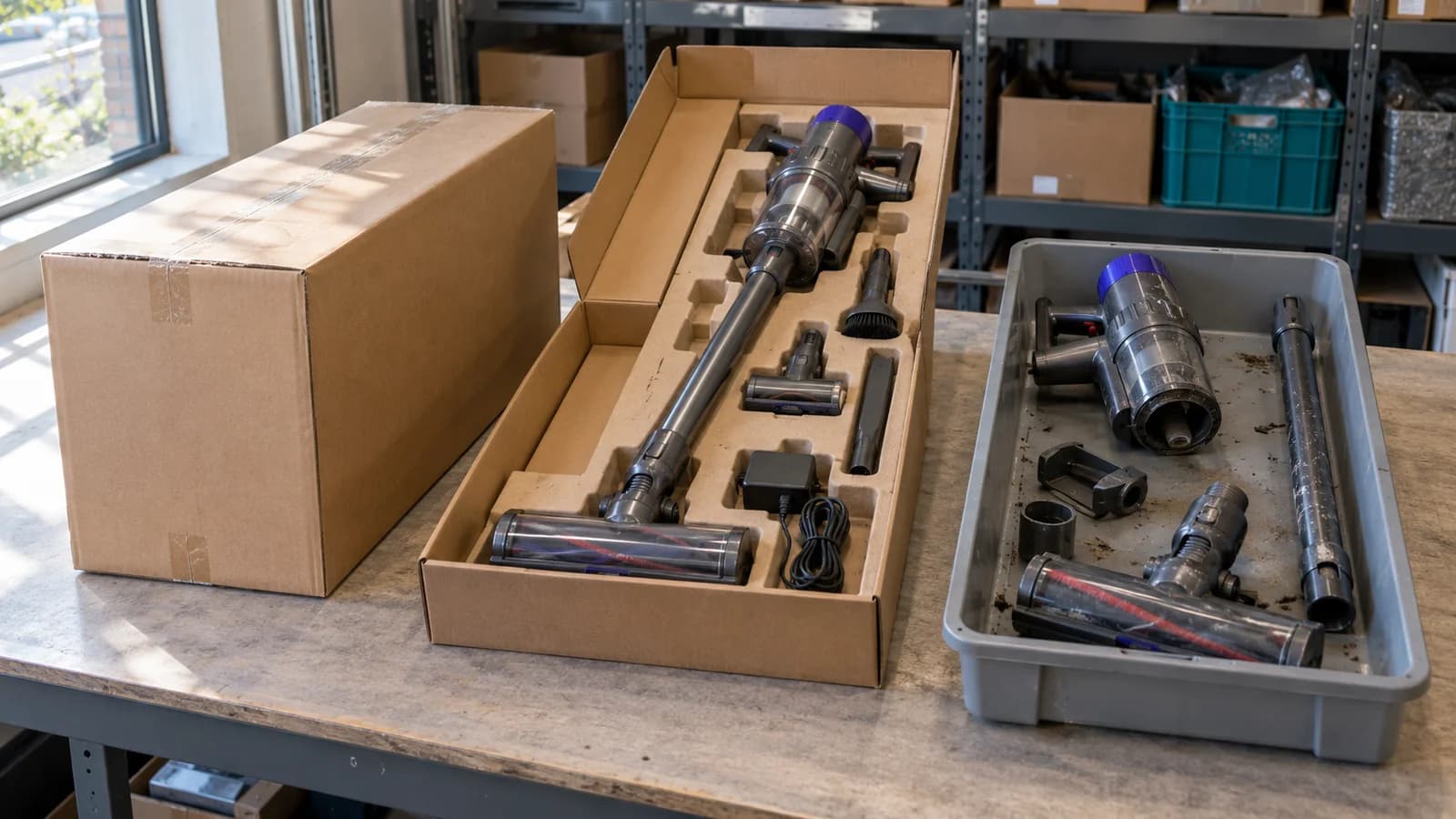
For example, an opened cordless vacuum with a charger and attachments is a different offer from a clean vacuum body missing its charger. Even if both units work, the second needs a replacement part or a different listing description.
Research replacement availability before assuming that a missing part is inexpensive. A part that cannot be sourced changes your selling plan even when its hypothetical price looks manageable.
Refurbished: ask who did what
Refurbished should prompt questions about the work performed, who performed it, and what documentation supports the description. It should not be treated as a synonym for manufacturer-certified.
Ask which functions were tested, whether repairs were made, whether accessories are original or replacements, and whether any stated warranty transfers to your buyer. Verify those details in the terms rather than assuming a familiar brand stands behind the lot.
Keep cosmetic grade separate from function. Two functional products can need different resale descriptions because one has visible wear. Their prices should reflect the condition you can honestly list, not the condition implied by the most favorable photograph.
Untested returns: unknown is not working or broken
Untested means you lack a test result under the seller's definition. Counting every unit as working is speculation. Counting every unit as failed may also misdescribe the inventory.
For a bid decision, separate that uncertainty from the physical facts. You can exclude unsupported revenue or model a cautious scenario without claiming to know the outcome.
In a fictional ten-unit lot, suppose you have clear descriptions but no functional tests. You do not yet have ten verified working units. Record ten units with unknown function, then decide whether the acquisition price supports the inspection risk.
If you cannot inspect before buying, your budget needs room for an outcome worse than your preferred scenario. If it only works when every unit succeeds, the plan depends on a fact you do not have.
Salvage and parts-only: a different business model
Salvage can involve missing components, damage, failures, or stock intended for parts recovery. Use the seller's specific description, because the term does not promise a consistent mix.
The relevant buyer may be a repair specialist rather than a consumer seeking a ready-to-use product. Your ability to identify, remove, test, store, and sell parts matters as much as the original product name.
Do not count a complete working product's sold price as support for a parts-only unit. Likewise, adding advertised prices for every component assumes all those parts exist, work, and find buyers. That needs evidence, not arithmetic alone.
If you lack the equipment, knowledge, or buyer base for parts inventory, passing can be more sensible than bidding lower and hoping.
Safety checks belong before resale
Condition grading does not replace a product-safety review. Check exact models against recall information and keep potentially affected items out of saleable inventory while you investigate.
The U.S. Consumer Product Safety Commission's guidance for retailers and reverse-logistics providers explains that selling recalled consumer products is prohibited. Follow the applicable recall instructions rather than treating a discount or a working power test as a remedy.
Use qualified help where a category requires it. This article is not a repair procedure or a substitute for product-specific safety requirements. A pallet's price does not justify skipping those checks.
A seven-step receiving and inspection routine
- Preserve purchase records. Keep the listing, manifest, condition definitions, invoice, and written seller clarifications together.
- Document receipt. Photograph packaging and visible shipment condition before reorganizing the stock, following the seller's delivery instructions.
- Reconcile identity and counts. Compare physical items with the manifest, including sets and multipacks.
- Separate unknowns. Keep items needing identification, recall review, or specialist assessment out of the ready-to-sell group.
- Record inspection results. Note function, appearance, accessories, and packaging as separate fields.
- Choose an honest selling condition. Use the destination marketplace's definitions and disclose known defects or missing parts.
- Review the purchase. Compare actual results with your buying assumptions before ordering a similar lot.
Check claim procedures and deadlines before delivery. Your routine should preserve the evidence those procedures require, but it does not guarantee a claim will be accepted.
Track condition outcomes without inventing benchmarks
A small worksheet can improve repeat buying decisions. Record the seller, lot identifier, stated grade, category, units inspected, actual condition groups, and time spent preparing inventory.
Keep products still awaiting assessment separate from products confirmed saleable or unsaleable. Otherwise, an unfinished inspection can produce a misleading working percentage.
Start with narrow comparisons. Results from one model and seller do not establish a reliable rate for every electronics pallet. Record sample size and inspection method alongside any percentage you calculate.
For pricing, use evidence that matches the condition you can sell. Our manifest retail versus resale guide explains why a retail reference cannot answer that question. Our max-bid walkthrough shows how costs affect the amount you can pay.
Questions buyers ask about condition grades
Is overstock always better than customer returns?
Not for every buyer. Overstock may reduce some inspection uncertainty when the seller provides clear assurances, but demand, quantity concentration, storage, and acquisition cost still matter. Returns require a plan for uncertain condition. Compare the actual lot with your skills and selling channel.
Does Grade A mean new?
No universal definition makes that safe to assume. Read the seller's grade description and the lot's exceptions. Ask separately about testing, use, cosmetic wear, accessories, and packaging.
Can an untested item be listed as working?
Not merely because the source listing called it untested or because it looks clean. Establish the condition you can support, follow the destination marketplace's rules, and disclose what you know and what you have not verified.
Which condition should a new reseller start with?
Choose inventory whose inspection and selling requirements you understand. A clearly documented lot in a familiar category is easier to evaluate than an unfamiliar mixed lot with vague grades. Start with a manageable quantity rather than treating the lowest unit price as the best fit.
Buy the condition you can prove
Keep source labels, inspection results, and resale descriptions separate. That habit makes both buying and selling decisions clearer.
Use our manifest-reading checklist before researching prices. Then review the manifest in PalletWorth, keeping unsupported assumptions visible. The goal is a buying decision you can explain, including a decision to pass.
By PalletWorth. The cover is an AI-generated editorial illustration, not inspected customer stock. Examples are hypothetical. Condition definitions vary by seller, lot, and marketplace; consult the terms that apply to your purchase.